I built a social network that can never make money, on purpose
You don't have to choose between the network and the noise. You keep the people. You drop the crowd.
I wanted off social media and couldn’t leave.
Not because I enjoyed it. Because leaving costs something real, you lose the thread of people’s lives, you stop hearing about things, you find out about the grid penalty Hamilton got for impeding in quali afterwards during the race start, you don’t know who’s birthday it is because you cannot see people wishing online. Everyone I know who quit came back within a month, and not one of them came back because the app was good.
For a long time I thought of that as a personal failure of discipline. It isn’t. It’s the design working. The design thought out by the smartest people on earth, working the way it should.
Here’s the thing I’d ask you to sit with for a second: almost every single thing you hate about social media is the result of one fact, which is that the product has to make money from your attention.
Follow it through. Revenue comes from ads. Ads are worth more the longer you stay, so the feed never ends, the next video plays itself, and the ordering stops being chronological and starts being whatever keeps you scrolling. Ads are worth more when they’re targeted, so every tap, pause and hover gets logged, and the privacy policy grows another page. Ads are worth more if you come back tomorrow, so the app learns to interrupt you using a notification engineered not to inform you but to retrieve you. Streaks exist because loss aversion works. The red badge exists because it itches to open it.
None of that is evil. Nobody sat in a room and decided to ruin your afternoon. It’s how the world works. Every one of those choices is the rational thing to do if your revenue is a function of time-on-app, and a company that has to earn from your attention will keep rediscovering them no matter how many good people work there or how sincerely the founder means the apology.
Which means the fix can’t come from inside that model. You can’t ask a business to stop doing the thing that pays for it.
So I built Ringss on the opposite philosophy, and the philosophy is embarrassingly simple.
Never make any money
I am never going to earn a rupee from this app. Not ads, not data, not a subscription, not a boosted post, not sponsored placement in a feed. Ever.
That isn’t modesty. It’s the whole mechanism. If there’s no revenue, there’s no incentive, and if there’s no incentive, none of the machinery above ever gets built, not because I’m more principled than the people who built it, but because there is genuinely nothing for me in it. I don’t have to resist the temptation to keep you scrolling because I never have the temptation. Your time is not worth anything to me, in the only sense that matters here.
And there’s a second half, which is the part that makes it binding rather than a promise I’m asking you to take on faith: the entire thing runs on almost free infrastructure. There is close to no monthly bill. No server invoice, no burn rate, nothing due at the end of the month. And for the small amount there is, I am happy to pay for it to keep the mission going.
That matters more than it sounds. Most platforms don’t abandon their principles out of the intention to be villains, they abandon them because the money runs out and the ad deck is sitting right there in the drawer, and suddenly “just a small banner, just for now” is the reasonable-sounding thing in the room. A project with a cost structure of zero cannot be forced into that conversation. Nobody can pressure me into monetising something that doesn’t cost anything to run.
There’s a donate link. People who use it get nothing at all in return, no badge, no perks, no better ranking. Because the moment a donation buys something, I am incentivised to improve the funnel which gets me the donations, and we’re back on the road I’m trying to stay off.
Rings
The part of social media worth keeping is the people. The part worth losing is the audience.
So on Ringss, everyone you connect with gets privately sorted by you into one of four rings - Core, Inner, Outer, Reach - innermost to outermost. When you post something, you pick a ring, and it goes to everyone at that tier and everyone inside it. Post to Core and only your closest handful see it. Post to Reach and everyone you’re connected to does. A post is called a Eureka, after the guy in the bath.
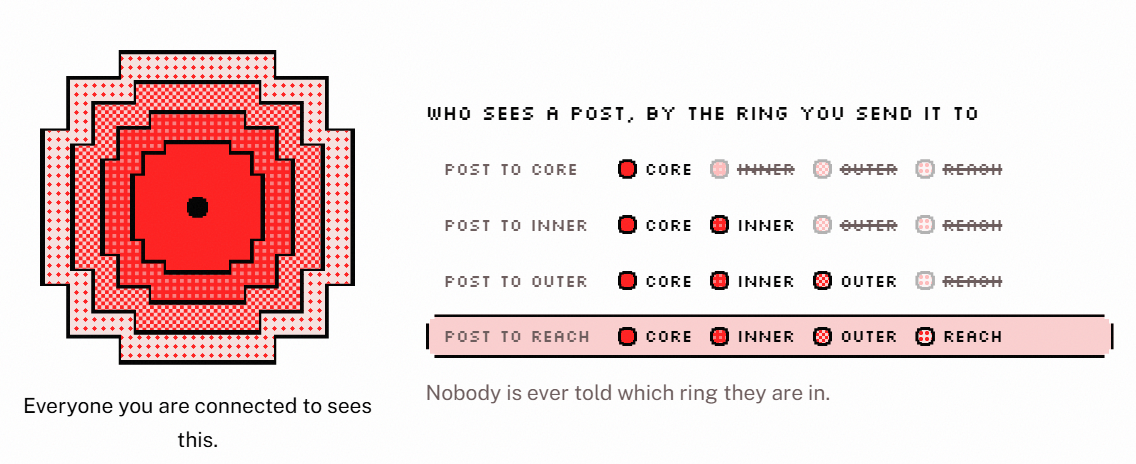
Two things about this.
The first is that you’re already doing it. The close-friends list. The second account for the eleven people who get the real posts, and the main one for everybody from school. Half the internet has independently invented ring-scoped posting as a workaround, maintained by hand, across two-three logins, because the platform gave them one undifferentiated crowd containing their best friend and their manager and expected them to speak freely into it. Ringss isn’t asking you to adopt a strange new habit. It’s taking the habit you already have and making it the actual feature.
The second is that a ring asks nothing of anybody. This is the part I care most about getting across. A ring is not a rank you give someone, not a friendship tier they have to live up to, not a contract. It’s a private note about how you see a person, a judgement you were already making silently, in your head, about who gets the unfiltered version of you, think about it. Putting it in the app creates no obligation in either direction. Nobody owes you a Core, and you owe nobody a promotion.
That’s exactly why where you put someone is absolutely, permanently secret. Not secret as a privacy feature, secret as the thing that makes the whole idea work. The moment a person can discover which ring they’re in, your private perception becomes a public statement about them, and then it stops being perception at all. It becomes a politeness contest, everybody gets moved to Core to avoid the awkwardness, and the feature is dead.
So, moving someone between rings is silent, and they’re never told. Readers can’t see which ring a post was addressed to, only the author sees that, on their own posts. And nothing anywhere in the app behaves differently depending on a ring. The only thing a ring may ever change is whether a post is visible at all. A button that quietly disappears on a Core post would tell you exactly where you stand without a single word on screen.
What this buys you is the thing that stops people leaving. You don’t have to choose between the network and the noise. You keep the people. You drop the crowd.
Nothing here decides anything for you
Every single thing you do on Ringss is something you chose to do. That sounds like a small claim until you notice how little of your time on any other app clears that bar.
The feed is chronological. There is no algorithm, no ranking model, no second pass, no “you might like.” There are a few alternate orderings and each one is a single sentence you read before you pick it - newest, most discussed, strongest signal, most contested. If you can’t explain an ordering in one line, it’s deciding for the reader rather than serving them.
Pagination is a button you press. The infinite scroll exists to make stopping an act of will, so here it’s the other way around: continuing is the act of will, and doing nothing ends the session. Nobody is notified when someone reacts to their post, that’s a permanent rule. There’s no karma, no total score, no profile counter presented as an achievement, because a leaderboard is a treadmill with numbers on it.
The reaction is where this gets physical. There’s no like button. Every post carries a slider: drag toward Amplify, drag toward Dampen, or leave it in the centre, which counts as deliberate neutrality rather than silence. A like is a reflex — a thumb twitch you’ve performed ten thousand times. Choosing a position on a scale takes a moment of actual judgement. That friction is the point, and it’s the rare case where the more thoughtful interaction also happens to be the less compulsive one.
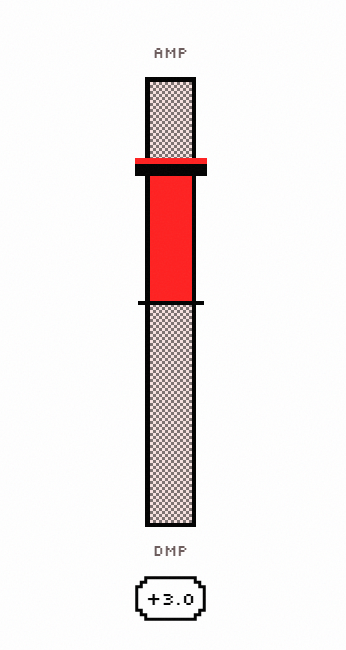
It also preserves information a like button destroys. Ten people who mildly approved and ten people who are violently split produce the same number on every other platform. Here they don’t. The aggregate (the Signal) is pulled toward neutral when few people have answered, so one enthusiast can’t make a post look universally acclaimed. And a post whose responses are genuinely divided gets a Contested badge, styled as an invitation rather than a warning, because on a platform about ideas the divisive one is the interesting one. You can sort a feed by it. An ordering that deliberately surfaces disagreement is the structural opposite of an engagement feed.
One more: the aggregate stays hidden until you’ve moved your own slider. Seeing the crowd first anchors you to it, which quietly turns an opinion instrument into a conformity meter.
Now notice something about that entire list. Every item on it is something an ad-funded product couldn’t ship even if it wanted to. Chronological feeds lose to ranked ones on time-on-app. A button instead of infinite scroll costs sessions. Not notifying people costs return visits. Hiding the score costs engagement. These aren’t virtues I’m claiming, they’re just what you build when nobody’s paying you for the alternative.
Communities, and why they’re free forever
There’s an obvious flaw in a purely private network, which is a brand-new user with zero connections opens the app and sees nothing. Not “not much”, nothing indefinitely, until they personally recruit people onto a platform nobody’s heard of.
Communities are the way in. Named shared spaces with their own membership and their own chronological feed. A club, a course, a reading group, a team, just a group of people with a shared interest/mindset. Rings play no part inside one, a community post goes to that community’s members and nobody else. And being in a community with someone gives you no access to their personal feed. If you two want that, one of you sends a connection request like anyone else.
I had planned Communities originally to be the revenue line, Charging the big ones like College clubs, businesses, etc per seat, that was the plan. I moved them to the front door instead, and once they were the front door, charging became obviously indefensible. You don’t put a paywall on the mechanism that makes your product usable in the first place. More to the point, seat pricing is exactly the first step back onto the road this entire project exists to stay off, which is, the day I have income to protect is the day I start making decisions to protect it.
They’re free. They’re going to stay free.
The companion
One feature I’ll mention because people might find this contradicting. Every user gets a small companion, an AI persona shaped by your own writing that can draft a comment in your voice on a post you’re reading.
It never acts on its own. Not once, not as an option, not later. Every draft happens because you explicitly asked for one, and every draft is shown to you before anything is posted. You edit it, approve it, or throw it away. It levels up from your own activity and what that unlocks is cosmetic: hats, essentially. Nothing it does gives you reach, visibility or advantage.
Why did I make this feature? Well, I thought it was really cool :) lol.
It’s live, and I’d like you to come
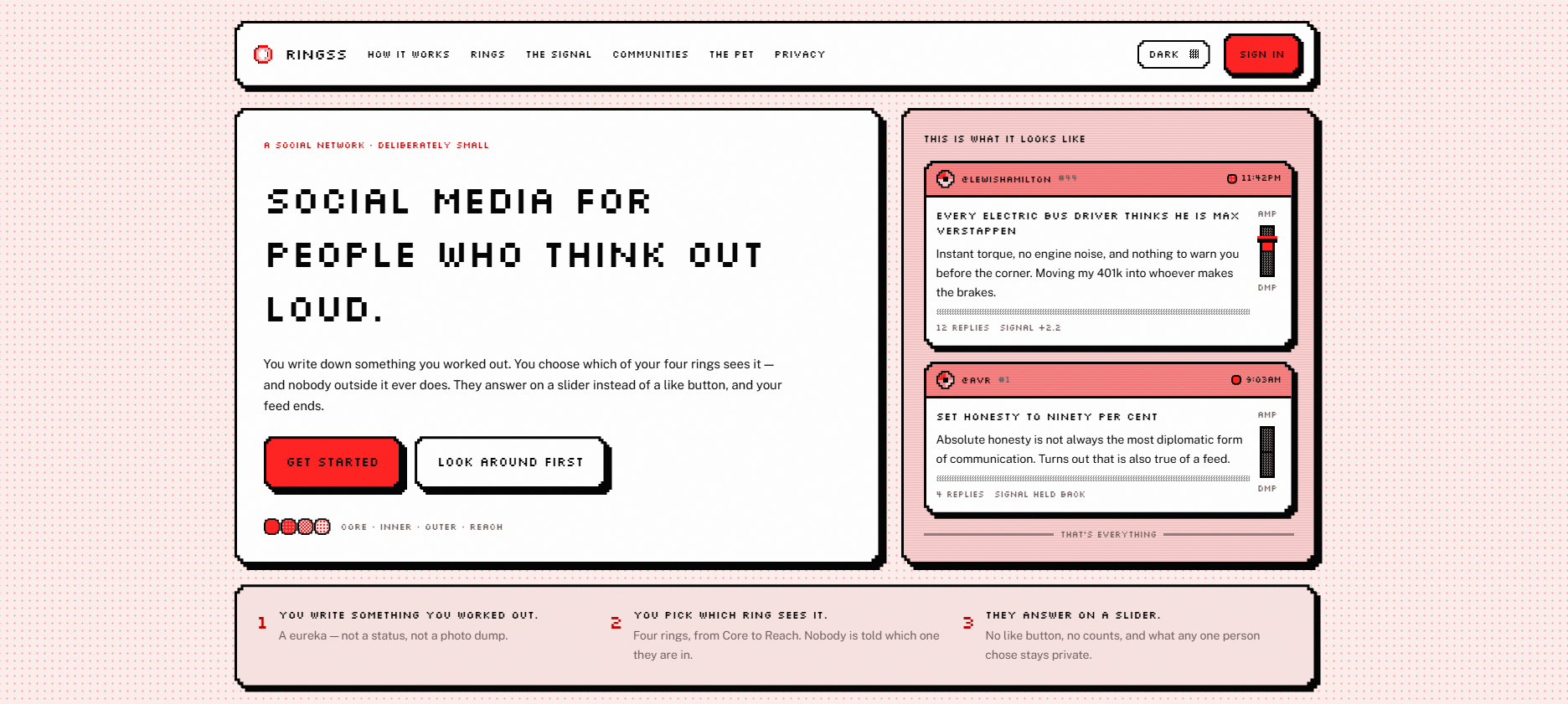
Ringss is at ringss.app. It’s open, you can sign up today, and it’s free, and i mean TOTALLY FREE. Not free-for-now, not free-until-we-figure-out-monetization. Free because the entire design rests on it never making money.
I’ll be honest about what I don’t know. The riskiest assumption in this whole thing was never the slider or the infrastructure. It’s whether will people actually have long, thoughtful conversations when you hand them a small, trusted audience? I believe they will. I built everything to find out as early as possible. But nobody knows until there are people in there, and right now there mostly aren’t.
So two asks.
Sign up. Take a few minutes with it. If something’s broken or stupid, do tell me. There’s a button in the app for exactly that.
And bring a group with you. This is the honest one. A social network is not a thing you can meaningfully try alone, and Ringss works the moment there are people in it who already know each other. If you’re in a college club, a course batch, a reading group, a team, a WhatsApp group that’s been going for four years, make that a community here and paste the invite code in. One group arriving brings an entire existing set of relationships with it, and that is genuinely the whole growth plan. There is no other one. There’s no algorithm to push it into feeds, no ad budget, no viral mechanic bolted on the side, because every one of those things is what I was trying to get away from.
Just people telling other people. Which, if it works, will be the most on-brand possible way for this thing to grow.
My username is avr. Do send me a request to let me know you signed up!
So, do join. We might just be a part of something great in the years to come.